Published: 20/07/2026
Updated: 20/07/2026
St Philip’church in Caerdeon, Gwynedd, has never done what it’s told. From the moment it was built to the bells that don’t ring so much as chime, this is a church that has cheerfully ignored every convention going. Storm damage forced it into silence a few years ago. This summer, thanks to bell historian Chris Pickford and our conservation partners at the Natural Building Centre, St Philip’s has found its voice again.
Join our Estate Officer, David, on site to find out more about this special church.
You'd walk straight past St Philip's if you didn't know it was there: a small, iron-stone chapel up a lane above the Mawddach estuary, more like a cottage that wandered into a churchyard by accident. It closed for worship in 2014 and came into our care in 2021, one of more than seventy churches across England and Wales that would otherwise have been left to fall apart.
Built in 1862 as a private chapel for the Reverend William Edward Jelf, so that his Oxford students could worship in English during their summer visits, it promptly landed its founder in court. Welsh-speaking parishes were required by statute to hold services in Welsh. Jelf lost the case at the Court of Arches. But his ally the Bishop of Bangor took the fight to the House of Lords instead, and won: the Act that followed, passed as a direct consequence of this one small church, opened the door to English-language worship in private chapels across Wales. Not bad for a building you can barely find.
The architecture would prove just as divisive. Jelf's brother-in-law, the Reverend John Louis Petit, was a fierce critic of the fashionable Gothic Revival and designed St Philip's to look nothing like a conventional Victorian church. It was closer, one unimpressed critic wrote at the time, to "something between a large lodge gate and a lady's rustic dairy." It remains the only building Petit ever completed. St Philip's is now Grade I listed for precisely the qualities that so annoyed his contemporaries, a stubborn protest against uniformity.
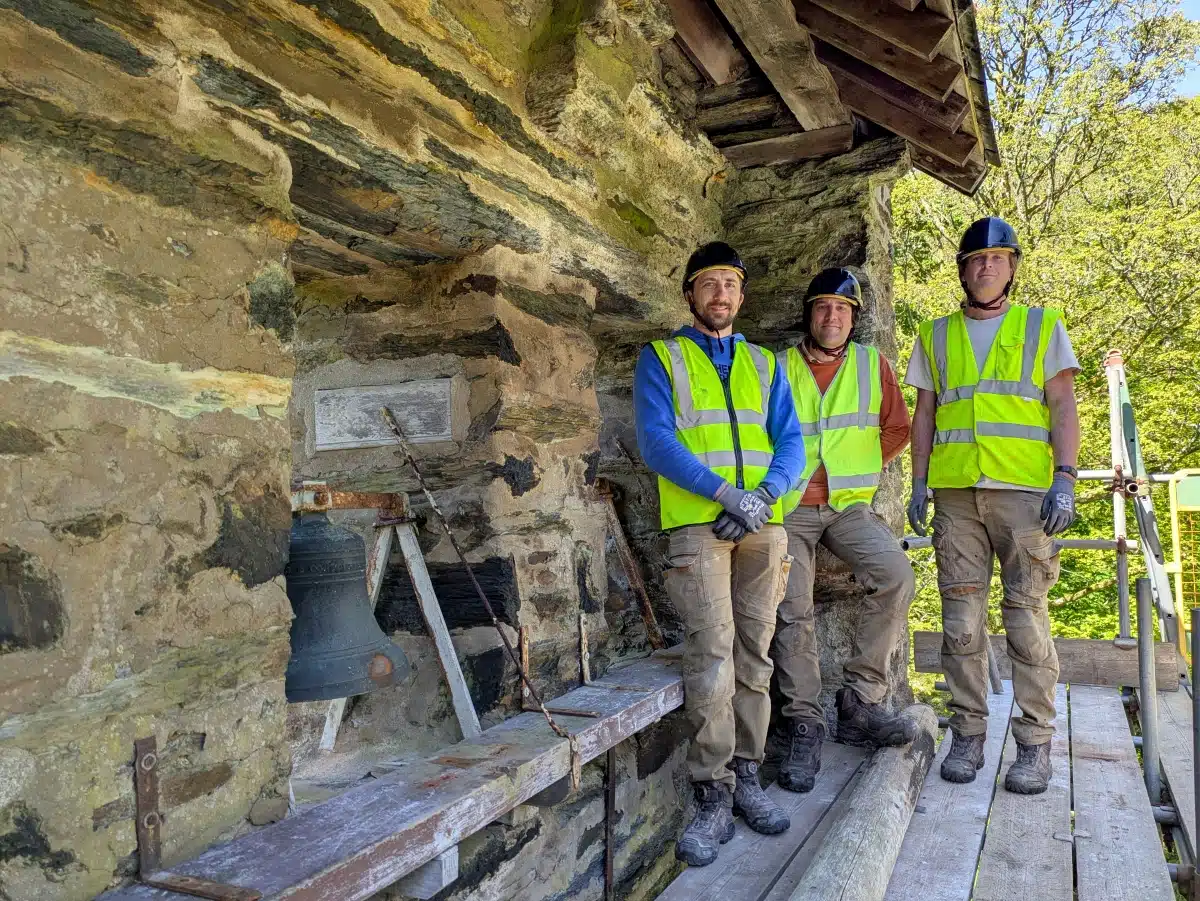
And then there are the bells. They don't swing on ropes like normal bells. They hang fixed in the tower and are struck, in turn, by hammers on a slowly rotating beam, a mechanism so unusual that bell historian Chris Pickford, who came to inspect them this summer, calls it simply "a wall of bells."
"You just get a simple tune, one, two, three, four, highest to lowest, that repeats," he says. "Quite a pretty little sound, really."
Before any repairs began, Pickford recorded each bell's note for the Dove’s Guide for Church Bell Ringers (the biggest online database of church bells around the world), so the entry can finally be brought up to date - important, careful work that keeps a building like this legible to future historians.
The culprit turned out to be worn-out springs. They're meant to hold each hammer clear of its bell between strikes; once they failed, the hammers just sat against the bronze, rusting where metal met metal. The fix was mostly patience - de-rusting, repainting, replacing every spring- apart from one fiddly problem: two of the hammers had drifted out of position, so instead of a clean four-note run you got an odd double-strike then a gap. Getting the timing right was the last job. "It's really nice to finally get up here and put it all back together," Ned Scharer of the Natural Building Centre says.
None of this happens without the people who fund it. Our thanks go to Chris Pickford, Ned and his team at the Natural Building Centre, and, as ever, to our members, donors and supporters, whose generosity is what keeps a place like St Philip's standing, open, and making a noise. Following the repairs, St Philip's is open daily: come and hear the bells for yourselves this summer.