
Published: 24/10/2026
Updated: 26/10/2026
An extraordinary collection of medieval Christian wall paintings, hidden beneath centuries of limewash and later paint, has been revealed at a church in rural Wales.
The exciting discoveries – including rare images of Christ and a vivid scene of the miracle of St Nicholas – were discovered during a rescue mission at St Lawrence’s, Gumfreston in Pembrokeshire.
You can read an article about this project, and our work in general, in The Financial Times.
The paintings were uncovered during restoration work at St Lawrence’s, Gumfreston, just a mile outside Tenby. St Lawrence’s origins lie in the late 12th century, with architectural additions reflecting the mercantile wealth of nearby towns and villages. Fragments discovered on the nave walls point to a richly decorated interior in the Middle Ages, with rich, colourful Biblical imagery on the nave and chancel walls.
The Reformation saw religious imagery systematically removed from churches across England and Wales, and Gumfreston was no exception. The paintings were covered with limewash. A Victorian attempt at restoration encased many of the paintings in cement. Later, layers of thick emulsion from unsympathetic repair work further concealed the artwork, with only fragments remaining visible.
But in 2021, the church closed. Ivy was choking the building, a leaky roof meant water was pouring in, destroying pews and rotting timbers. Bat droppings littered the floor. The wall paintings were at serious risk of being lost forever.
Thanks to two grants – one from Cadw and one from the National Heritage Memorial Fund – we were able to take St Lawrence’s into our care. It joined around 70 churches that had been rescued, repaired and reopened by the Friends.
Once the church interior had been stabilised, conservators were able to get to work to rescue the wall paintings. Wall-painting conservators Jane Rutherfoord and Naomi Cox carefully removed the later decoration to uncover evidence of successive schemes of medieval painting, from decorative patterns and flowers to human figures, animals and Biblical scenes.The paintings were uncovered during restoration work at St Lawrence’s, Gumfreston, just a mile outside Tenby. St Lawrence’s origins lie in the late 12th century, with architectural additions reflecting the mercantile wealth of nearby towns and villages. Fragments discovered on the nave walls point to a richly decorated interior in the Middle Ages, with rich, colourful Biblical imagery on the nave and chancel walls.
The Reformation saw religious imagery systematically removed from churches across England and Wales, and Gumfreston was no exception. The paintings were covered with limewash. A Victorian attempt at restoration encased many of the paintings in cement. Later, layers of thick emulsion from unsympathetic repair work further concealed the artwork, with only fragments remaining visible.
But in 2021, the church closed. Ivy was choking the building, a leaky roof meant water was pouring in, destroying pews and rotting timbers. Bat droppings littered the floor. The wall paintings were at serious risk of being lost forever.
Thanks to two grants – one from Cadw and one from the National Heritage Memorial Fund – we were able to take St Lawrence’s into our care. It joined around 70 churches that had been rescued, repaired and reopened by the Friends.
Once the church interior had been stabilised, conservators were able to get to work to rescue the wall paintings. Wall-painting conservators Jane Rutherfoord and Naomi Cox carefully removed the later decoration to uncover evidence of successive schemes of medieval painting, from decorative patterns and flowers to human figures, animals and Biblical scenes.


The work has revealed far more than the fragmentary paintings previously visible. At the chancel arch and on the east wall, several generations of decoration survive on top of one another, creating a remarkable record of how the church’s interior changed over the centuries.
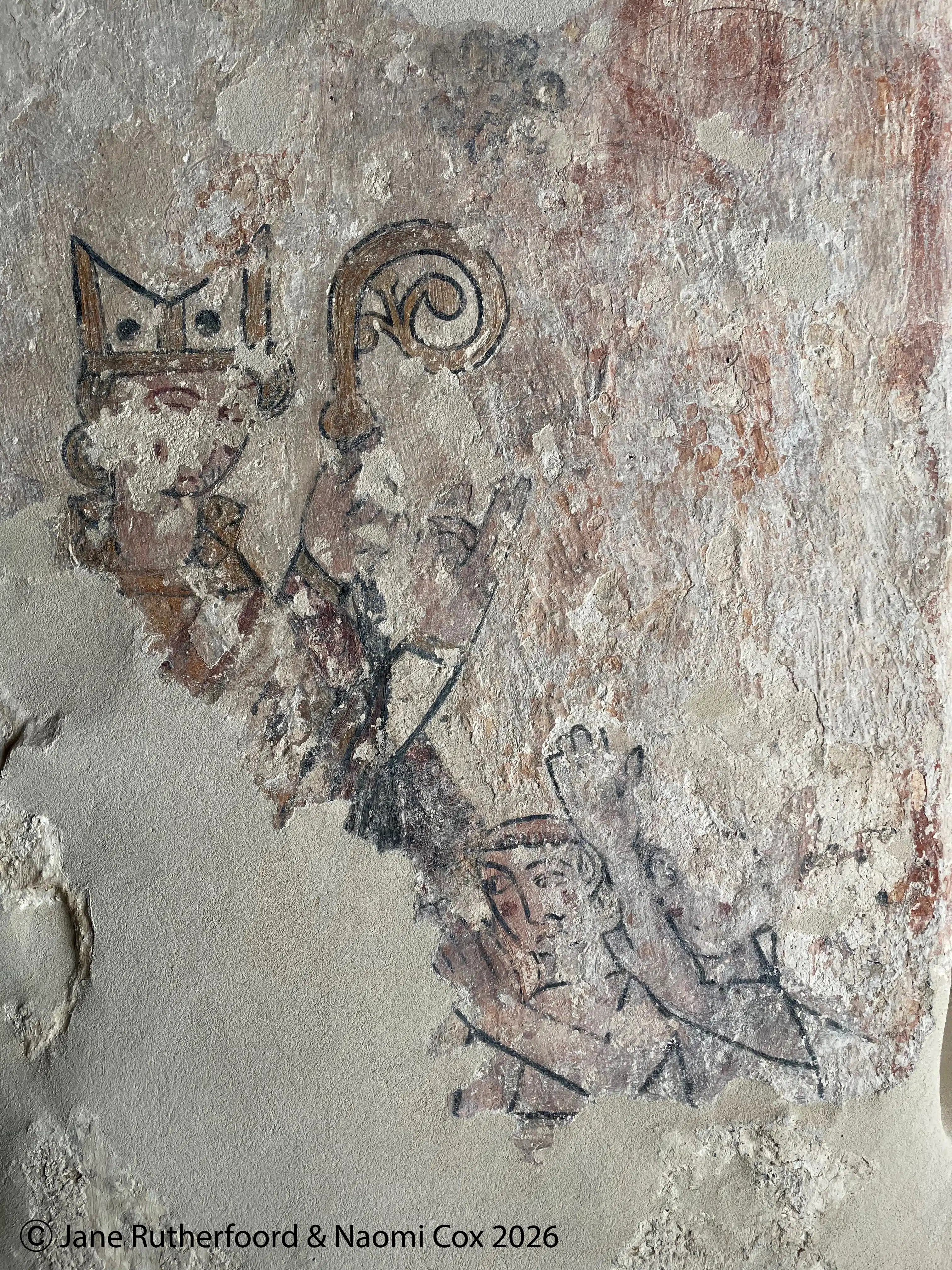
One of the most striking discoveries is a scene depicting St Nicholas, the bishop whose miracles became central to medieval Christian tradition. The painting appears to show the saint restoring three young scholars who had been murdered by an innkeeper and his wife and hidden in a pickling tub. The surviving details include the bishop’s mitre and crozier, his raised hand in blessing, and the figures of the tonsured men as the bishop resurrects them, while their killers watch on.
On the north wall, conservators have also been able to make sense of a painting that had already been documented but had badly degraded. It depicts the Warning to Sabbath-Breakers: an image of Christ whose body is surrounded by tools representing work that should not be undertaken on the Sabbath. Only four examples of this subject are known in Wales.

Conservator Jane Rutherfoord said: “Beneath the emulsion lay distemper, gypsum repairs, a nineteenth-century lime skim-coat (painted pale blue) and, round the painting, the 1869 cement. The emulsion had had a devastating impact: it was impermeable and had trapped the walls in the equivalent of a plastic mackintosh, thereby creating a wet micro-climate in which biological growth could flourish at multiple levels – and in many forms.”
The conservation has required painstaking work. Using dry, mechanical techniques under magnification and raking light, the conservators have worked through the layers one at a time. The result is a layered history of the church’s interior.
The earliest surviving parts of St Lawrence’s date from around the twelfth or early thirteenth century. The paintings offer a new way to understand the church not simply as a historic building, but as a place whose walls once communicated stories, beliefs and warnings to its congregation. Some of the decoration may be considerably older than the most recognisable figurative scenes, although its precise date remains uncertain.
Rachel Morley, Director of Friends of Friendless Churches, said: “We knew there was something precious at Gumfreston, but we could not have imagined quite how much the church still had to tell us. These paintings have been hidden for centuries, and bringing them back into view is extraordinary. There is still so much we don’t know, and that is part of what makes this discovery so exciting.”
St Lawrence’s has now been repaired and reopened, and the conservation work is allowing its walls to tell a story that has remained largely hidden for generations. The paintings are fragile, and their investigation is ongoing, but already they have revealed a rich and unexpectedly complex picture of medieval religious art in a small Welsh church.
We couldn’t have rescued St Lawrence’s without grants from Cadw, the National Heritage Memorial Fund, and The Pilgrim Trust. Our heartfelt thanks also go to our member who remembered St Lawrence’s church in their Will and to all our supporters, donors, and members who made this project possible.

